Showing posts with label fruits. Show all posts

Thursday, June 5, 2014

Juicing

When I say juice.. I don't mean fruit juice! I mean veggie juice! RAW veggie/fruit juice. Truth is, we shouldn't really drink store bought pasteurized fruit juice. It is a dead food source full of fructose and artificially added nutrients that are not easily absorbed. Fructose is very hard on the liver and is one of the causes of fatty liver diseases. One 6 oz glass of orange juice is equivalent to eating 6 oranges at one time!

There are many varieties of juicers on the market... Dr. Gerson's therapy (watch The Gerson Miracle)  recommends a food press. As we researched food presses, we came across the Angel masticator... it actually tested better than the press the Gerson Institute recommends. This decision was based on sturdiness of the juicer (all stainless steel), the oxidation of the food (how fast the nutrition is lost) and the ease of use and cleanup. Joe Cross of 'Fat, Sick and Nearly Dead' (watch movie) uses a Breville and they seem to be fine for the average juicer.

The goal of juicing is to get as much RAW nutrition in your body as you can! If you can eat a cucumber, then eat it and add it to your juice, but don't just drink cucumber juice... add a zucchini and a bunch of greens, then add an apple.

Also there is a lot of talk about the difference in juicing vs. smoothies... with the introduction of the nutribullet. The difference as I see it is.. if you are sick or overweight and need emergency care... JUICE.. it is the fastest way to get the most amount of nutrition in your body at one time. But beware of too much fruit... to much fruit without the pulp can raise blood sugar... so if you are diabetic be aware of this! If you are simply wanting a quick healthy cold snack... by all means through some frozen berries and a handful of spinach in your blender and have a smoothie! I will do a separate post on smoothies :)

I have researched food groups and colors and have found that juicing by color works the best. It creates less separation in the juice... which says to me, a more symbiotic relationship!

So If I am juicing green, I would use the color spectrum of green, yellow and white.
Red would be red, orange, yellow and white...
Purple would be purple, blue, red and white...
Orange would be yellow, orange and white...
See the pattern? Maybe from my artist side using the color wheel  :D


Here is a chart I use for basic color nutrition.

This has been a hard post for me to do because I don't use a recipe... my friends and mother beg me for recipes of all kinds of things.. but I truly don't use them and find it stifling to try to create one from what I cook! It is instinct and that is hard to measure! LOL All fruits and veggies are different size, so the taste is always going to be different from one day to the next!

The beauty of juicing is... you can NOT mess it up! If it is too strong, add another piece of fruit, if it is too sweet add more veggies... VOILA... fixed... to YOUR taste!

Also, I juice according to what I have on hand... what I have from my garden or what is seasonal. Now somethings are so important I will buy them all year, like kale... but when it is from my garden... I will use what I can, when I can!

I tested out Joe Cross's juice recipe for my BFF and scaled it to a quart...

1 lime (peeled)
2 small carrots (they separated, not sure except to add sweet)
1 green apple
1 green pear
3 stalks of celery
stems of 1 broccoli crown (leaving florets for dinner)
2 broccoli florets
1 cucumber
1 bunch of kale (or 2 handfuls of power greens)

This made 1 quart with a smidgen left over. It was tasty.

The main reason we bought the Angel juicer is because the juice is good for 3 days with no oxidation...  oxidation is when you cut an apple and it turns brown, or you peel a potato or carrot and it turns brown.

But what do we know, I have read a study that every cut on a carrot that creates oxidation releases nutrients that would not be there otherwise... so I take what I learn with a grain of salt and hope and pray I learn more tomorrow and adjust to my new knowledge! :D

My typical green is (anything green, yellow or white)
1-2 buches of kale (different varieties)
2 medium zucchini (very neutral flavor)
2 large cucumbers (very neutral flavor)
1/4 to 1/3 head of green cabbage (very neutral flavor)
1/4 to 1 /3 head of cauliflower (very neutral flavor)
1large turnip
1 pineapple
1 mango
2 kiwi

The goal is 3/4 veggie ratio to 1/4 or less fruit. This makes 3-4 quarts depending on the size of stuff. My family of 3 drinks this much juice in 2 days usually very easy. 

The beauty of juicing is.. if you don't like pineapple, change it to a green apple and a lime.. easy fix!

Last fall, I ordered 3 varieties of apples to can apple sauce for the winter (it was awesome, btw)...
I had a lot of apple cores and peels left over, so I made a light green juice to use them up.
I juiced the apples 1st and got about 4 cups of apple juice, which is nothing like store bought! It is a powerhouse of LIVING RAW nutrients.. and I do give my child raw fruit juice often.
To 1 cup of apple juice I added...
3 zucchini
1/3 head green cabbage
1/3 head cauliflower
1/2 bunch of celery *(I forgot that)


A typical 'orange' juice would be (anything orange, yellow or white)
6 large carrots
2 sweet potato
2 yellow squash
1/3 head cauliflower
1 parsnip
1 orange
1 red plum
1 peach
if you like peppers.. a yellow or orange peeper is good
also spaghetti squash, butternut and pumpkin are great adds!

A typical purple would be (anything purple, blue, red or white)
1 eggplant
1/3 head purple cabbage
purple carrots (if I could find)
purple kohlrabi (kind of strong, so beware) 
1/3 head cauliflower
2 red plums
a handful of blueberries 
a handfull of blackberries
1 beet *(I forgot that)
maybe a apple if not sweet enough


My typical red is strawberry banana... not all juicers do banana puree (I do it 1st and catch under where the pulp comes out.
2 bananas pureed
1 quart of strawberries
2 roma tomatoes
3 large carrots
1 sweet potato
1 red apple
2 yellow squash
1 beet *(I forgot that)
1/3 head of cauliflower

NEVER USE CITRIS PEEL or just a tiny bit for zest, but the inside white layer is bitter.

My philosophy on juicing is... juice things you would not normally eat RAW... like kale or turnips or parsnips... think outside the box! Get creative and see what RAW veggie you can add for it's benefits and hide with fruit... then as you go... nibble on it raw while you are juicing... you will be amazed how your tastebuds come alive! In no time, your palette will completely change! 

As for the kids... start a little fruitier and see what you can get away with! If they are open, get them involved... if they are not and run from the thought of veggies... hide what you can and let them in on it slowly :D they will be amazed when they find out! It starts with an open mind!

If you need it a little fruitier to get started, do it! Then as your tastebuds get adjusted, cut the fruit back a little each time until you get a 3/4:1 ratio!

Spicy/strong veggies would be greens, peppers, jicama, turnip, parsnip, kohlrabi
Neutral veggies are eggplant, squash, zucchini, green cabbage, cauliflower.

Smell, taste, be adventurous! Happy juicing!

Tuesday, October 22, 2013

Clean food for dummies...

OK clean food for dummies was requested by my best friend and others :D...

Start simple until it becomes more natural. Don't overwhelm yourself with the details! Simply start 1 item at a time, replacing with a better item as you go. It took about 3 months to have a complete change over in our pantry, fridge and freezer.. It is more expensive, until you get going, it killed me the 1st few months to buy meat and cheese, but once I was in rotation and had a stock pile, the replenishing was easier and cheaper because I didn't need so much! Now I have an entire shelf full and simply buy a few a month and keep the rotation going!

This is a starting place... once this becomes more common.. I will add more details and change some of this, but this helps in the transition phase!

When I brown ground meat, I mix 1/3 chopped nuts and 1/3 cooked steel cut oats.. it makes the meat go farther and adds plant protein into the mix so your body gets multi-proteins at one time! When making hamburgers I do the same but add an egg or 2 to help bind it. Seasoning is your best friend! The meat from the store is loaded with chemicals and salt.. the farm meat is NOT! Use good salt freely and good vinegars help break down animal protein. I use organic raw apple cider vinegar, red wine, balsamic, etc.  Find organic seasoning in bulk, it is much cheaper and keep in the fridge or freezer to keep it from losing it's nutrients. I am fortunate that I have a Mennonite bulk food store where I can get my spices, grains, beans, legumes and some whole grain organic pastas.


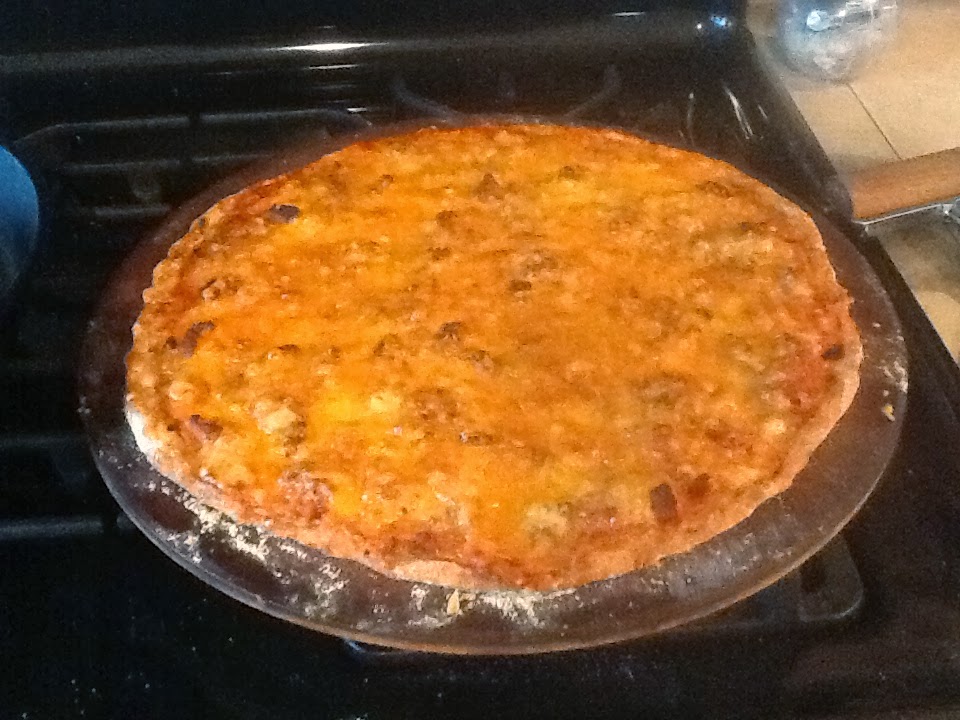
This was ground lamb with what I picked out of the garden that day.. some green beans, peppers and tomatoes chopped up and tossed in with a lil oil to sauté and a splash of water and lid to steam, then added my browned lamb (it was only 1/2 lb, I have used the other 1/2 for pizza).

It really isn't hard.. it is more a change in mind and attitude.. take back your food and take back responsibility of your own health! Retrain your brain... we created a bacon cheese burger (3x the animal products in 1 meal)... have the burger but leave the other off for another meal to cut the amount of animal products you take in!

Buy meat and dairy from a local grass fed and raw farm operation. I use http://www.jakoinc.com in Hutch who delivers to Wichita bi-weekly... but there are many others.. check this site to find in your area! http://www.localharvest.org   Jako pastures beef, pork, lamb and chicken. I get my animal food there also (because the same junk is in our animal food also and it is cheaper than the good stuff at the pet store). They have raw milks, cheeses, keffir, yogurts, whey, wholesome delight, which is delightful and many other products. They have an apple orchard, so apple sauce, cider, vinegar... honey... assorted veggies in the summer and frozen in the winter! This farm is 1/3 of my regular shopping! It makes it much easier that way!

Wild caught fish and seafood. Do some research on this.. a lot is very pricey! We stick mainly to salmon, tilapia and Mahi mahi. We don't do bottom dwelling cleaners like shrimp, crab, lobster or catfish. A lot of wild caught fish is not fished in a sustainable way (meaning they put in a large net for one kind of fish, catch all in the area and kill what they don't want!) Wasting and depleting the fish! This is not a practice we will be a party to out of principle alone!


Lots of fresh raw fruits and veggies... the more local and seasonal the better, but this takes time to get to... there are phytonutrients only available in the raw form... when cooking, lightly steam as much as possible... juicing is a great way to get raw nutrition and open your pallet to new flavors! Munching on the raw while you are juicing is a great way to get more familiar! Throw out most of your old recipes that called for pre-made soups and sauces, do a google search for new healthier versions. Take your favorite family recipes and convert them to using whole raw organic ingredients... message me if you need help! I took our favorite chocolate cookie recipe and cleaned it up!


If you are not grain, bean or legume sensitive... buy organic in bulk... I know the Dillon's marketplaces around Kansas have bulk bins until you can find smaller more local stores to shop in! Black beans, pinto beans, lentils, black eyed peas, kidney beans (highest fiber content), garbanzo, etc...
soak them well, rinse and drain often to get anti-nutrients out... do a larger quantity and put in glass jars (with headroom) and freeze or can (follow instructions)... we make our own hummus as well!

Steel cut oats, rices (brown, long, short, wild, as many varieties as you can find, except stripped white), polenta (corn, if you are not sensitive), wheat berries, quinoa, millet, etc (there are lots, but check the glycemic index if you are diabetic). Simply start introducing new grains into your existing oat or rice when you make it... For example.. add 1/4 cup quinoa into 1 cup of rice blend. The taste of quinoa can be strong, so start small and build up. The red quinoa has more fiber and nutrients than the white.

I almost forgot seeds and nuts.. buy raw unsalted and lightly toast and salt yourself. Put in a bowl ad a drizzle of grapeseed oil and salt... toss, then turn out on a cookie sheet and toast for just a few minutes on 350º... the smaller the seed the less time... 5 minutes for sunflower and pumpkin seeds... the larger, up to 10 minutes. Will focus on this more later!

My basic oat blend is 3 cups of water with 1 cup of steel cut oats and 1-2T of raw butter or coconut oil cooked for 20 minutes with the lid ajar. Then I open the lid and add 1/4 cup of oat bran, 1/4 cup ground flax seed and 1/4 cup chia seeds... you can add 1/4 cup of polenta and or wheat berries earlier in the cooking. Experiment with it! If you let cool with lid on it holds more of the 'gel', if you cool with the lid off and stir occasionally it becomes drier (more like rice when heated with butter or oil added). I make this in quantity to have for the week.. we eat for breakfast, sweet or salty... for lunch with other things chopped on top and as a complex carb for dinner.


I keep organic spelt flour and stone ground corn meal (we seem to be corn sensitive, so this is going bye bye) for the small amount of baking I do. Pizza crust, cookies, cakes, cinnamon rolls, pancakes, etc. (not a huge amount.. make a batch and freeze most for later, a cookie a week to feel like you are not deprived). The hardest part is training your mind that our culture is centered around eating food that makes us feel good! Re-train your mind as you re-train your pallet! Think of food in the simplest most basic forms and build lightly from there! We have a small amount of organic whole grain pasta... I use my own organic canned sauce, organic ricotta, parmesan from the farm, load it with veggies and make organic lasagna occasionally. Rarely do I add meat because of the cheese content.

I buy Ezechiel bread, english muffins and tortillas by the case and keep in freezer... it is sprouted grains... a living grain! Changes it from a grain to a vegetable! It is the only thing we eat except the few things I make!

Celtic sea salt (might be iffy these days with radioactivity from Fukushima)... Mediterranean sea salt... Pink Himalayan is probably the best! Use liberally.. it is the source for a lot of natural minerals and if helps detoxify the body!

Organic local raw unfiltered honey, maple syrup and small amounts of turbinado (unprocessed) sugar for sweetener when needed.

Fats... olive and coconut oil for raw and up to medium heat cooking... grapeseed oil and raw organic butter for high heat cooking. Do not heat flax seed oil, only use it raw and cool!  No corn, soy or canola EVER! Even organic! The omega 3/6 ratio is off and not healthy.

If you need sauces like ketchup, mustard, jellies, the extras... look for organic or make your own, the internet is a valuable resource for recipes!

Happy getting started! I will start posting exact recipes and pictures as we go!